
The Fastest Way to Get a Competitor Benchmark Wrong Is to Trust the First Plausible Answer
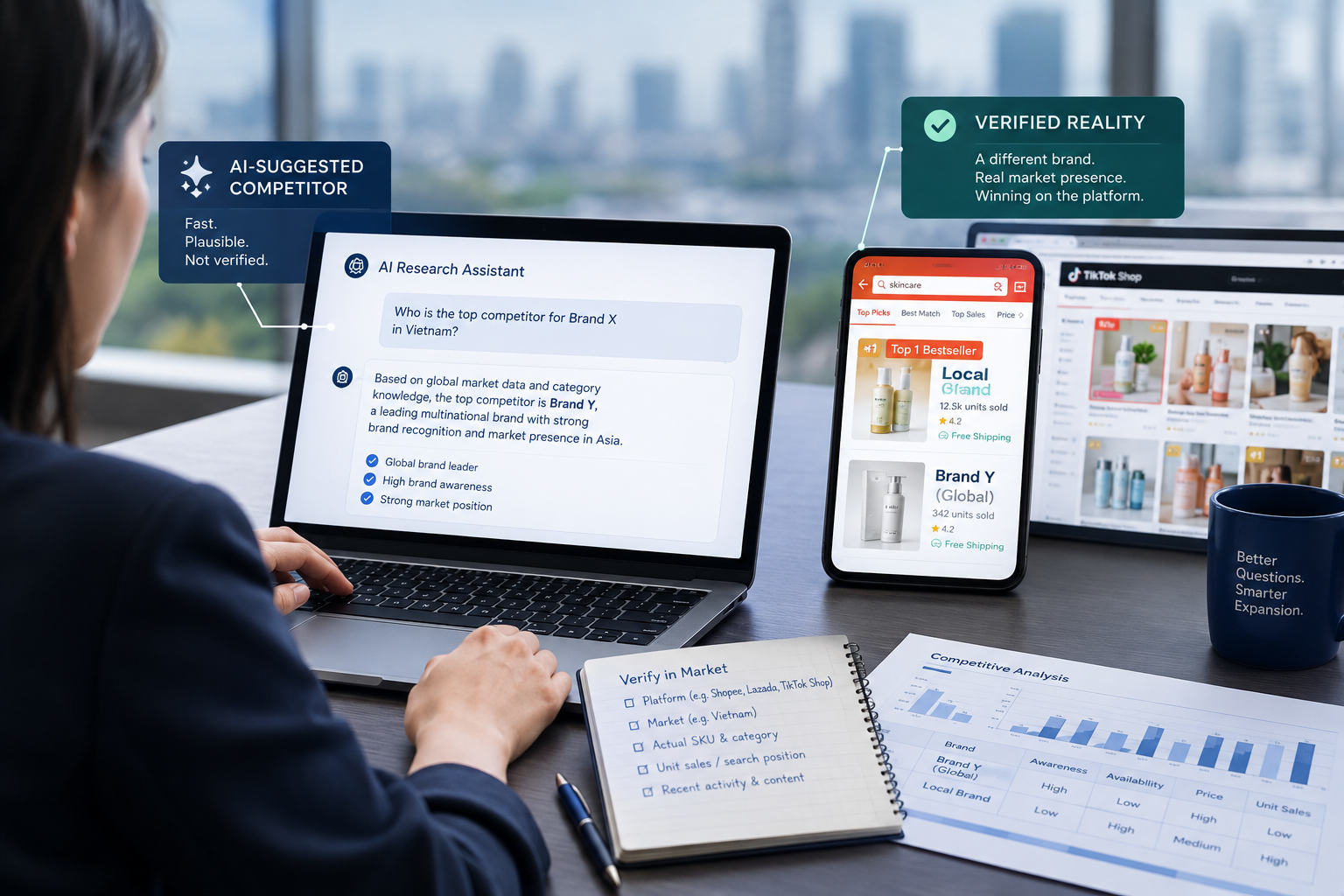
AI research tools have made competitive analysis faster than it has ever been. They have not made it more accurate, and the gap between those two things is exactly where a lot of expansion brands are quietly exposed, usually without knowing it.
Ask an AI research tool who a brand's top competitor is in a given market, and it will return an answer with total confidence, usually the globally recognized name in the category. That answer can be correct. It can also be a brand with negligible actual presence on the specific e-commerce platform being analyzed, in that specific market, while a far less visible regional competitor is the one actually winning search position and unit sales there. The tool is optimizing for a plausible answer, built from general category knowledge and training data, not a verified one, built from checking what a shopper actually sees on the platform today.
A team that treats that first answer as settled fact builds an entire competitive picture on top of it, awareness gap, availability comparison, pricing position, using a foundation nobody actually checked against the market. Every subsequent number in that analysis can be calculated with complete accuracy and still be answering the wrong question, because the one input that everything else depends on was never confirmed.
Speed and verification are not the same thing, and the first should never quietly substitute for the second, particularly at the exact step everything downstream is built on. A fast wrong answer costs more than a slow right one, because the wrong answer does not announce itself. It simply produces a competitive analysis that looks complete and is not.
FRAMEWORK CONNECTION
This is why Samana Insights' Brand Performance Analysis framework treats manual verification as a mandatory checkpoint in its first stage, before any AI-sourced data is entered into the underlying analysis, rather than a quality check applied afterward once the numbers already look finished.
See how a structured verification step changes the reliability of competitive intelligence.
